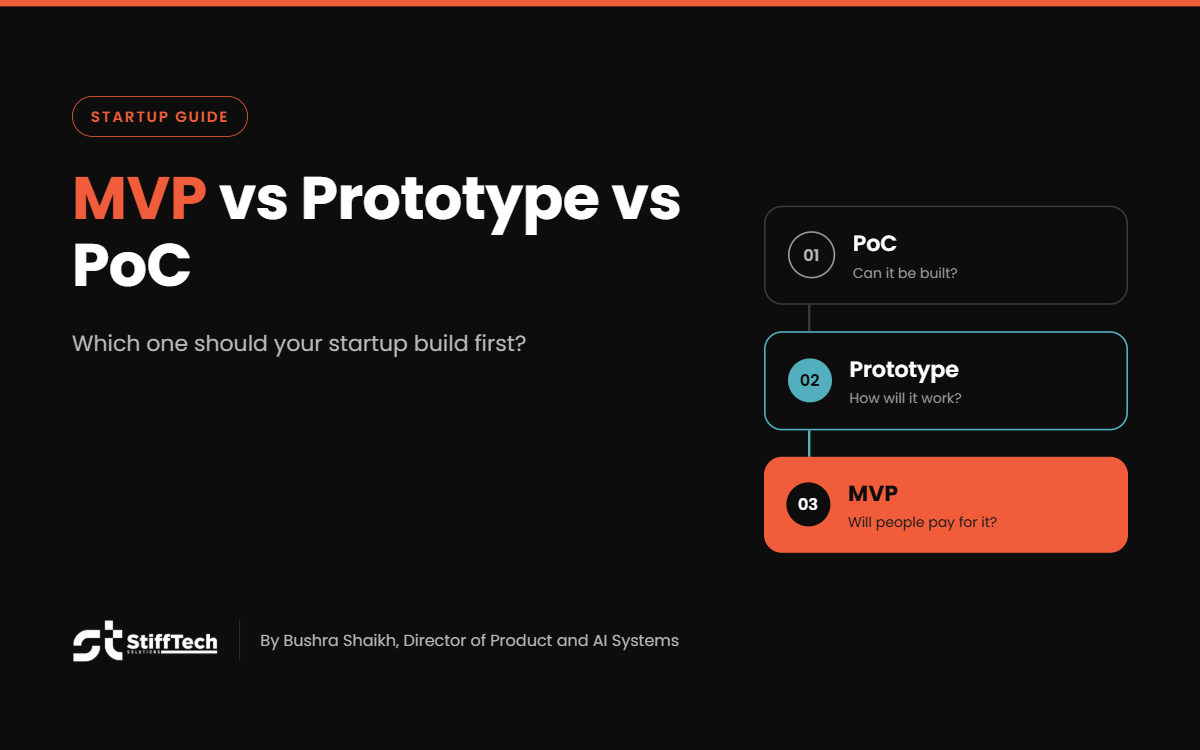
Three terms, three different questions
Founders often use PoC, prototype and MVP as if they mean the same thing. They do not. Getting MVP vs prototype vs PoC right matters because each one answers a different question, and building the wrong one first is one of the most common ways early budgets get burned.
Quick answer. A proof of concept (PoC) tests whether an idea is technically possible. A prototype tests how the product will look and work for users. A minimum viable product (MVP) is a working product released to real users to test whether they will actually use or pay for it. Most startups move from PoC (only if there is technical risk) to prototype to MVP.
What each one is
Proof of concept (PoC) answers “Can this be built?”
A PoC is a small technical experiment. It checks whether a specific idea works before you invest in a product around it. It is usually internal, rough and never shown to customers.
You need a PoC when there is real technical uncertainty. For example, can an AI model read your invoices accurately enough? Can your system pull live data from a farm-equipment API? Can a phone camera track a golf swing in real time?
If your product uses well-known technology (a booking app, a dashboard, an online store), you can usually skip the PoC. In proof of concept vs MVP terms, a PoC proves the technology works, while an MVP proves people want it.
Prototype answers “How will it work for users?”
A prototype shows the product’s screens, flows and interactions. It can be a clickable design in Figma or a lightweight front-end with sample data. It does not need a real back end.
A prototype is where you catch misunderstandings early. Founders, investors, the development team and a handful of target users can all click through it and say “this is not what I meant” while changes are still cheap. That is the real difference in prototype vs MVP. One tests the flow, the other tests the market.
MVP answers “Will people use it or pay for it?”
An MVP is a real, working product with only the core features needed to deliver value. It runs on real infrastructure, handles real data and is released to real users.
The goal is learning, not perfection. You launch, measure how people use it, and decide what to build next based on evidence instead of opinions. A good MVP is lean but built on an architecture that can grow into the full product.
PoC vs prototype vs MVP at a glance
| Proof of concept | Prototype | MVP | |
| Question it answers | Can this be built? | How will it work and feel? | Will people use or pay for it? |
| Main risk it reduces | Technical risk | Usability and scope risk | Market risk |
| Who sees it | Internal team | Founders, investors, test users | Real users and customers |
| Working back end | Partial, only what is tested | No (sample data) | Yes |
| Typical output | Small experiment or demo | Clickable screens and flows | Live web or mobile product |
| Relative effort | Low | Low to medium | Medium to high |
| What you learn | Feasibility | Whether the flow makes sense | Real demand and behaviour |
Which one should you build first?
In MVP development for startups, the right starting point comes down to three questions, answered in order.
- Is there a real technical unknown? If a core part of your idea depends on something unproven (a new AI use case, an unusual hardware or API integration, heavy real-time processing), start with a PoC. If not, skip it.
- Is the product flow agreed and tested? If the screens, user journeys and feature list are still being discussed, build a prototype next. Put it in front of five to ten target users before writing production code.
- Are the scope and flow clear? Then build the MVP and get it into real users’ hands as soon as possible.
Here are some practical examples.
- An AI document-processing tool for SMEs. PoC first to prove accuracy on real documents, then prototype, then MVP.
- A service marketplace (customers, vendors, admins). Skip the PoC and start with a prototype to agree the flows for each role, then MVP.
- An operations SaaS like fleet or laundromat management. Prototype first to map the workflows with operators, then an MVP on a multi-tenant architecture, as we did for Laundry X360.
- An ecommerce brand’s custom store. Usually straight to a prototype of key pages, then build.
Common mistakes to avoid
- Calling a prototype an MVP. A clickable design proves nothing about demand. Investors and users can tell the difference.
- Building a PoC nobody needed. If the technology is proven, a PoC just delays your launch.
- Skipping the prototype. Going straight to code without agreeing the flows leads to rework, which is far more expensive in development than in design.
- Overloading the MVP. Adding “just one more feature” turns a lean test into a slow, costly build. See what drives MVP development cost.
- Building a throwaway MVP. Lean does not mean disposable. Poor early architecture forces a rebuild just when you start to grow.
How Stifftech runs the sequence
Our MVP development process combines these stages into one clear path, owned by one team from start to finish.
- Discovery call. A free 30-minute session to understand your idea, your users and the riskiest assumption.
- PoC, only if needed. When there is a technical unknown, especially in AI systems, we test it first so you do not build on guesswork.
- Scope of work and initial prototype. Once the scope is shared, we build an initial prototype so you can see exactly how the product will work before you commit to the full build.
- Professional proposal. A detailed proposal based on the agreed scope, with timeline and milestones.
- MVP build and launch. A lean, production-ready MVP on an architecture that can scale. Learn more about our MVP development services.
Frequently asked questions
What is the difference between a prototype and an MVP?
A prototype shows how a product will look and work, usually without a real back end. An MVP is a working product with core features, released to real users to test demand.
Do I always need a proof of concept?
No. A PoC is only needed when there is genuine technical uncertainty. For products built on proven technology, you can go straight to a prototype.
Does Stifftech build PoCs, prototypes and MVPs?
Yes. Stifftech runs all three stages with one team, starting with a PoC only when there is a real technical unknown, then a prototype, then the MVP.
Does Stifftech share a prototype before the final quote?
Yes. Once you share your scope of work, Stifftech builds an initial prototype so you can see how the product will work, then sends a professional proposal based on the agreed scope.
How do I start a project with Stifftech?
Book a free 30-minute consultation with our lead consultant. We will review your idea, tell you honestly which stage you need first and outline the next steps.
Not sure where to start?
Tell us about your idea and we will tell you honestly whether you need a PoC, a prototype or an MVP first. Share your scope and we will turn it into an initial prototype and a professional proposal.
Book a free 30-minute consultation or send us your project details.
Written by Bushra Shaikh, Director of Product and AI Systems at Stifftech Solutions.
Leave a Reply