Blog

  • MVP vs Prototype vs PoC, Which One Does Your Startup Need First?

    MVP vs Prototype vs PoC, Which One Does Your Startup Need First?

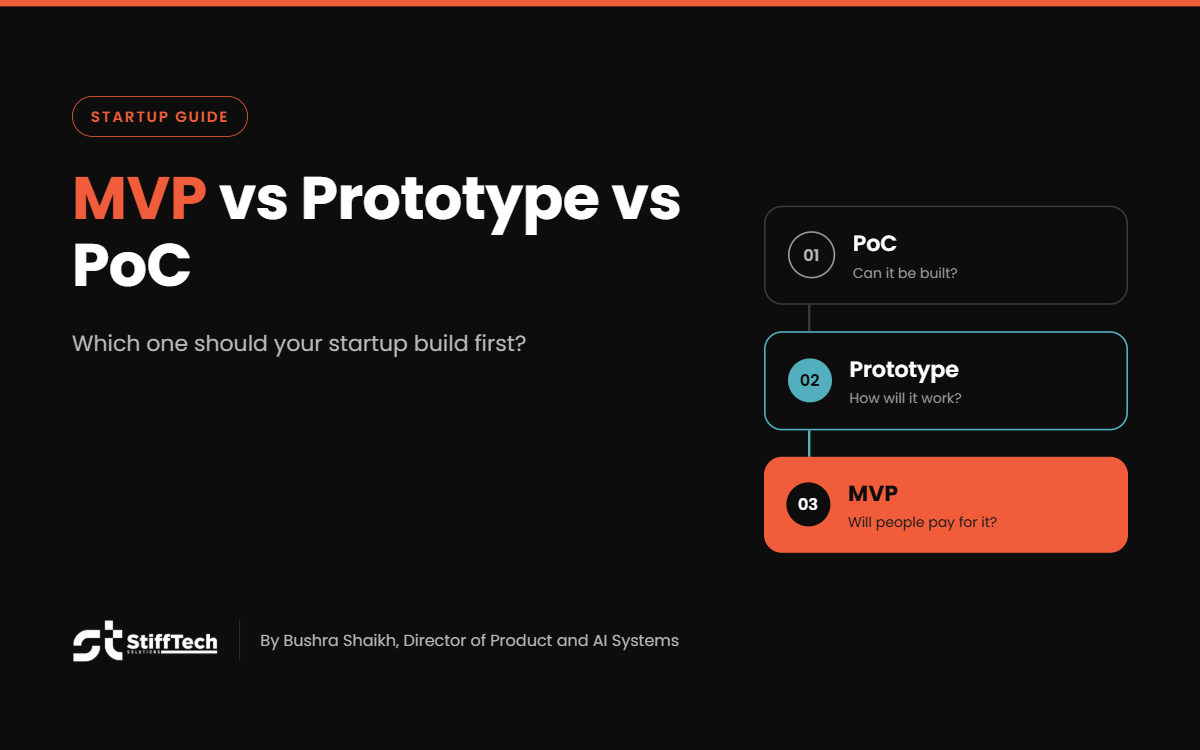
    Three terms, three different questions

    Founders often use PoC, prototype and MVP as if they mean the same thing. They do not. Getting MVP vs prototype vs PoC right matters because each one answers a different question, and building the wrong one first is one of the most common ways early budgets get burned.

    Quick answer. A proof of concept (PoC) tests whether an idea is technically possible. A prototype tests how the product will look and work for users. A minimum viable product (MVP) is a working product released to real users to test whether they will actually use or pay for it. Most startups move from PoC (only if there is technical risk) to prototype to MVP.

    What each one is

    Proof of concept (PoC) answers “Can this be built?”

    A PoC is a small technical experiment. It checks whether a specific idea works before you invest in a product around it. It is usually internal, rough and never shown to customers.

    You need a PoC when there is real technical uncertainty. For example, can an AI model read your invoices accurately enough? Can your system pull live data from a farm-equipment API? Can a phone camera track a golf swing in real time?

    If your product uses well-known technology (a booking app, a dashboard, an online store), you can usually skip the PoC. In proof of concept vs MVP terms, a PoC proves the technology works, while an MVP proves people want it.

    Prototype answers “How will it work for users?”

    A prototype shows the product’s screens, flows and interactions. It can be a clickable design in Figma or a lightweight front-end with sample data. It does not need a real back end.

    A prototype is where you catch misunderstandings early. Founders, investors, the development team and a handful of target users can all click through it and say “this is not what I meant” while changes are still cheap. That is the real difference in prototype vs MVP. One tests the flow, the other tests the market.

    MVP answers “Will people use it or pay for it?”

    An MVP is a real, working product with only the core features needed to deliver value. It runs on real infrastructure, handles real data and is released to real users.

    The goal is learning, not perfection. You launch, measure how people use it, and decide what to build next based on evidence instead of opinions. A good MVP is lean but built on an architecture that can grow into the full product.

    PoC vs prototype vs MVP at a glance

    Proof of conceptPrototypeMVP
    Question it answersCan this be built?How will it work and feel?Will people use or pay for it?
    Main risk it reducesTechnical riskUsability and scope riskMarket risk
    Who sees itInternal teamFounders, investors, test usersReal users and customers
    Working back endPartial, only what is testedNo (sample data)Yes
    Typical outputSmall experiment or demoClickable screens and flowsLive web or mobile product
    Relative effortLowLow to mediumMedium to high
    What you learnFeasibilityWhether the flow makes senseReal demand and behaviour

    Which one should you build first?

    In MVP development for startups, the right starting point comes down to three questions, answered in order.

    1. Is there a real technical unknown? If a core part of your idea depends on something unproven (a new AI use case, an unusual hardware or API integration, heavy real-time processing), start with a PoC. If not, skip it.
    2. Is the product flow agreed and tested? If the screens, user journeys and feature list are still being discussed, build a prototype next. Put it in front of five to ten target users before writing production code.
    3. Are the scope and flow clear? Then build the MVP and get it into real users’ hands as soon as possible.

    Here are some practical examples.

    • An AI document-processing tool for SMEs. PoC first to prove accuracy on real documents, then prototype, then MVP.
    • A service marketplace (customers, vendors, admins). Skip the PoC and start with a prototype to agree the flows for each role, then MVP.
    • An operations SaaS like fleet or laundromat management. Prototype first to map the workflows with operators, then an MVP on a multi-tenant architecture, as we did for Laundry X360.
    • An ecommerce brand’s custom store. Usually straight to a prototype of key pages, then build.

    Common mistakes to avoid

    • Calling a prototype an MVP. A clickable design proves nothing about demand. Investors and users can tell the difference.
    • Building a PoC nobody needed. If the technology is proven, a PoC just delays your launch.
    • Skipping the prototype. Going straight to code without agreeing the flows leads to rework, which is far more expensive in development than in design.
    • Overloading the MVP. Adding “just one more feature” turns a lean test into a slow, costly build. See what drives MVP development cost.
    • Building a throwaway MVP. Lean does not mean disposable. Poor early architecture forces a rebuild just when you start to grow.

    How Stifftech runs the sequence

    Our MVP development process combines these stages into one clear path, owned by one team from start to finish.

    1. Discovery call. A free 30-minute session to understand your idea, your users and the riskiest assumption.
    2. PoC, only if needed. When there is a technical unknown, especially in AI systems, we test it first so you do not build on guesswork.
    3. Scope of work and initial prototype. Once the scope is shared, we build an initial prototype so you can see exactly how the product will work before you commit to the full build.
    4. Professional proposal. A detailed proposal based on the agreed scope, with timeline and milestones.
    5. MVP build and launch. A lean, production-ready MVP on an architecture that can scale. Learn more about our MVP development services.

    Frequently asked questions

    What is the difference between a prototype and an MVP?

    A prototype shows how a product will look and work, usually without a real back end. An MVP is a working product with core features, released to real users to test demand.

    Do I always need a proof of concept?

    No. A PoC is only needed when there is genuine technical uncertainty. For products built on proven technology, you can go straight to a prototype.

    Does Stifftech build PoCs, prototypes and MVPs?

    Yes. Stifftech runs all three stages with one team, starting with a PoC only when there is a real technical unknown, then a prototype, then the MVP.

    Does Stifftech share a prototype before the final quote?

    Yes. Once you share your scope of work, Stifftech builds an initial prototype so you can see how the product will work, then sends a professional proposal based on the agreed scope.

    How do I start a project with Stifftech?

    Book a free 30-minute consultation with our lead consultant. We will review your idea, tell you honestly which stage you need first and outline the next steps.

    Not sure where to start?

    Tell us about your idea and we will tell you honestly whether you need a PoC, a prototype or an MVP first. Share your scope and we will turn it into an initial prototype and a professional proposal.

    Book a free 30-minute consultation or send us your project details.

    Written by Bushra Shaikh, Director of Product and AI Systems at Stifftech Solutions.
  • What Actually Drives MVP Development Cost (and How to Get an Accurate Quote)

    What Actually Drives MVP Development Cost (and How to Get an Accurate Quote)

    Why every agency gives you a different number

    Ask five MVP development companies what an MVP costs and you will get five very different answers. That is not because some of them are guessing. It is because “an MVP” can mean a clickable demo, a single-feature web app, or a full SaaS platform with payments, dashboards and AI.

    The number only becomes meaningful once the scope is clear. This guide to MVP development for startups walks through the factors that actually move an MVP budget, the costs founders tend to miss, and how to get a quote you can trust.

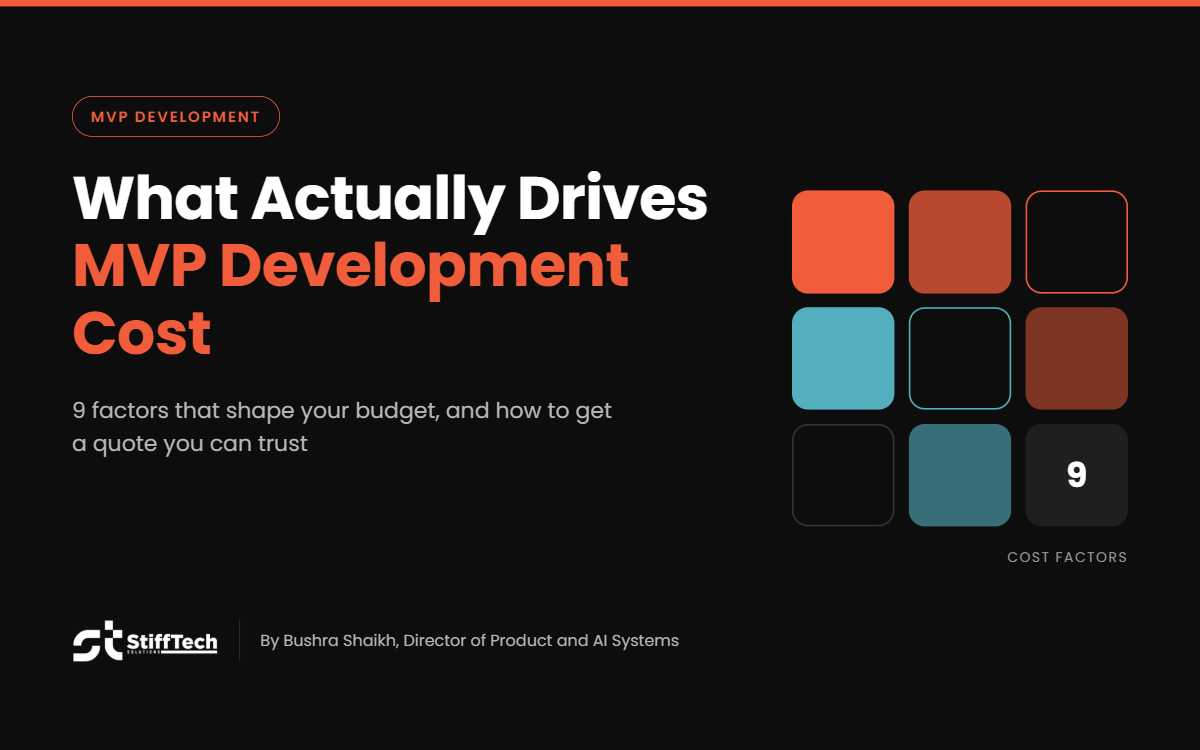
    Quick answer. MVP development cost is driven mainly by the number of core features, the platforms you need (web, iOS, Android), third-party integrations, AI or data components, design depth, compliance needs and the team model. The most reliable way to get an accurate figure is a short discovery phase that produces a written scope and a working prototype before the final quote.

    The 9 factors that shape your MVP budget

    1. Number of core features

    This is the biggest lever. Every feature needs design, front-end, back-end logic, testing and edge-case handling. An MVP built around one core job (for example, “book a slot,share MVP, prototype and pay”) is a very different project from one that also needs chat, referrals, reporting and an admin panel.

    A useful test is simple. If a feature does not help you prove the main assumption behind your business, it probably belongs in version two.

    2. Platforms (web, iOS, Android)

    A responsive web app is usually the fastest route to market. Native mobile apps add app-store requirements, device testing and release management. Cross-platform frameworks such as React Native or Flutter reduce duplication, but two mobile platforms plus web is still more work than one.

    Our Smart Golf project, for example, needed an iOS and Android mobile application. Still, due to budget constraints and because it was a startup, we suggested an MVP with a Web Application first (Smartgolfpro), and we are now in the second phase of developing the iOS and Android mobile application.

    3. User roles and permissions

    One user type is simple. A marketplace with customers, vendors, delivery staff and admins means separate flows, dashboards and access rules for each role. Every extra role multiplies screens and test cases.

    4. Third-party integrations

    Payment gateways, maps, SMS and WhatsApp, accounting tools, CRMs, ERPs and SSO all take time to connect and test properly. Some APIs are well documented, while others need workarounds. Regional choices matter too, because payment providers used in the UAE and Saudi Arabia differ from those common in the UK or US.

    5. AI and data components

    Adding an LLM-powered assistant, document processing, recommendations or predictive analytics changes the project. You now need prompt and model design, data pipelines, evaluation and monitoring, and often ongoing usage costs for model APIs. A simple AI feature on top of an existing workflow is far lighter than a product where AI is the core.

    6. Design depth

    A clean UI built from a proven component library is quick. Custom branding, motion design and detailed UX research take longer, but they can matter a lot in consumer products where first impressions drive retention.

    7. Architecture and scalability

    An MVP should be lean, but it should not be throwaway. Decisions such as multi-tenancy, database structure and cloud setup are much cheaper to get right early. For Laundry X360, a multi-tenant SaaS architecture with real-time fleet tracking was part of the foundation, because the product was built to serve many operators from day one.

    8. Security and compliance

    Healthcare, fintech and anything handling personal data needs extra care, including encryption, access controls, audit logs and, depending on the market, rules such as GDPR in Europe or UAE and Saudi data-protection laws. Building this in from the start costs less than retrofitting it.

    9. Team model and location

    Who builds it matters as much as what you build. A local in-house team, a freelancer network and a dedicated agency team all carry different costs and risks. Whether you work with an MVP development company in Dubai, the UK or offshore, the cheapest hourly rate is not always the lowest total cost, especially if the work needs to be rebuilt later. Also, going with an agency, you will have all things under one umbrella might increase the cost and insecurity as well.

    Hidden costs founders often miss

    The build is only part of the budget. Plan for these early so they do not surprise you after launch.

    • Cloud hosting and infrastructure. Servers, databases, storage and backups, which grow with your users.
    • Third-party subscriptions. Maps, SMS, email, payment fees and AI model usage.
    • App store accounts and reviews. Developer accounts and the time it takes to pass Apple and Google review.
    • Maintenance and bug fixes. Operating system updates, library updates and fixes found by real users.
    • Analytics and tracking. Setting up GA4, event tracking and dashboards so you can actually learn from the MVP.
    • Iteration after feedback. The whole point of an MVP is to learn and change. Budget for at least one round of improvements.

    How to keep your MVP cost under control

    1. Start from one problem. Write down the single assumption your MVP must prove. Every feature should serve that test.
    2. Rank features as must-have, nice-to-have and later. Only the first list goes into version one.
    3. Pick one platform first. Launch on web or on the platform your users actually use, then expand.
    4. Use proven building blocks. Authentication, payments and notifications do not need to be invented from scratch.
    5. Validate with a prototype before full development. A clickable prototype catches misunderstandings while they are still cheap to fix. If you are unsure which stage you need, compare MVP vs prototype vs PoC before you start.
    6. Choose a partner who owns delivery end to end. Split vendors and broken handoffs are one of the most common reasons MVP budgets overrun.

    How we scope and quote an MVP at Stifftech

    We do not publish a fixed price list, because a number given before the scope is clear is usually wrong. Instead, we follow a process that gives you clarity before you commit.

    1. Free 30-minute consultation. We talk through your idea, your users and the problem you want to prove. No sales script.
    2. Scope of work. We turn the conversation into a written scope covering core features, user roles, platforms, integrations and what is deliberately left for later.
    3. Initial prototype. Once the scope is shared, we build an initial prototype so you can see and click through how the product will work. It builds confidence on both sides and catches gaps early.
    4. Professional proposal. You receive a detailed proposal based on the agreed scope, with timeline, milestones and team.
    5. Build, launch and scale. One dedicated team takes the MVP from design to deployment, then helps you improve it with real user data.

    This is the same approach behind products such as Laundry X360 and Smart Golf. You can read more about our MVP development services.

    Frequently asked questions

    How much does it cost to build an MVP?

    It depends on scope. The main drivers are the number of core features, platforms, user roles, integrations, AI components, design depth, compliance and the team model. A written scope and a prototype are the most reliable way to get an accurate quote.

    How long does it take to build an MVP?

    Most focused MVPs take a few weeks to a few months, depending on scope and platforms. A clear feature list and fast feedback from the founder shorten the timeline more than anything else.

    Does Stifftech share fixed prices for MVP development?

    No. Stifftech prices every MVP from its scope of work. Once you share your requirements, we build an initial prototype and send a professional proposal with timeline and milestones, so the number you get is one you can rely on.

    Why does Stifftech build a prototype before the final quote?

    A prototype lets you see and click through the product before committing. It confirms that Stifftech has understood your idea, catches gaps early and builds confidence on both sides before full development starts.

    Which markets and industries does Stifftech build MVPs for?

    Stifftech works with startups and SMEs in the UAE, Saudi Arabia, the wider GCC, the UK, Europe and the USA. Our products span SaaS and fleet operations such as Laundry X360, sports and fitness apps such as Smart Golf, healthcare, fintech and ecommerce.

    Get a clear scope before you commit

    The fastest way to know what your MVP will cost is to put it on paper with someone who has built products like it. Share your idea with us, and we will turn it into a scope of work, an initial prototype and a professional proposal you can plan around.

    Book a free 30-minute consultation or send us your project details.

    Written by Bushra Shaikh, Director of Product and AI Systems at Stifftech Solutions.
  • Web App or Mobile App: Which Should You Build First?

    Web App or Mobile App: Which Should You Build First?

    Is it one of the first big forks in building any product: web or mobile? Founders often assume they need both from day one and then watch the budget and timeline double before they’ve validated the idea at all. Building both at once is the most expensive way to find out you built the wrong thing.

    The better move is to build one first, learn from real users, then expand. But which one? The answer isn’t about which is trendier; it’s about where your users actually are and what your product needs to do. Sound web app development choices start there, not with a coin flip. Here’s how to decide.

    Start With Where Your Users Actually Are

    Everything flows from one question: where and how will people actually use this?

    If they’ll use it at a desk, mid task, alongside other tools, that points to web. If they’ll use it on the move, quickly, tied to a phone’s camera, location, or notifications, that points to mobile. You’re not guessing at preferences here; you’re matching the product to the real moment it gets used.

    When a Web App Should Come First

    A web app is usually the smart first build when:

    • Your users work at a computer; this is common for most business and B2B tools
    • You want people to start instantly, with no app store download in the way
    • You need to ship fast and cheaply to test the idea
    • The product is content heavy, dashboard heavy, or built for longer sessions

    Web also has a quiet advantage: one build works across every device with a browser, so you reach the most people for the least effort. For many products, that makes it the fastest path to real feedback.

    When a Mobile App Should Come First

    Sometimes mobile clearly wins, and forcing web would cripple the product. Go mobile first when:

    • The experience depends on the phone camera, GPS, notifications, and offline use
    • People will reach for it many times a day, in short bursts
    • It’s fundamentally an on the go product, like delivery, fitness, or social
    • Push notifications are central to how it works, not a nice to have

    If your product only makes sense in someone’s hand, don’t bend it onto the web just to save money. Purpose built mobile app development is the right call there.

    The Option Most Founders Overlook

    There’s a middle path worth knowing about. A responsive web app can behave a lot like a mobile app, be installable and work on phones, and even send some notifications without the cost of a separate native build. And cross platform approaches let you build once and run on both iOS and Android, rather than building each twice.

    These aren’t right for every product, but they can get you to market faster and cheaper while you learn what your users truly need. Sometimes the best ‘web or mobile’ answer is ‘a bit of both, for now.’

    How Strategy and Engineering Work Together

    Choosing web or mobile isn’t just a technical preference; it shapes cost, speed, and how quickly you learn. That’s why it works best when strategy and engineering decide it together. Strategy weighs who the users are and what will validate the idea fastest. Engineering weighs what’s cheapest to build well and easiest to grow later.

    When those two align, you build the right platform once instead of paying to build the wrong one twice. And whichever you pick, starting with a lean first version lets real usage, not assumptions, tell you whether it’s time to add the other.

    The Bottom Line

    Don’t build both at once to hedge your bets; that’s the pricey road to a wrong guess. Start with where your users actually are: web when they’re at a desk and you want speed and reach, mobile when the product lives in their hand. Consider a responsive or cross-platform middle path to move faster. Then let real feedback decide what comes next.

    One platform, done right, beats two done in a rush.

    If you’re deciding between web and mobile for your product, that’s exactly the kind of call we help founders work through at Stifftech, matching the platform to your users, budget, and goals.

  • Signs It’s Time to Rebuild Your Software

    Signs It’s Time to Rebuild Your Software

    Every piece of software reaches a point where the question stops being ‘How do we add this feature?’ and becomes ‘Should we still be building on this at all?’ It’s an uncomfortable question, because a rebuild feels expensive and risky, so most teams put it off, patching and working around problems until the workarounds are the product.

    But there’s a real cost to waiting too long, too. The trick is telling the difference between software that just needs maintenance and software that’s genuinely holding your business back. That honest diagnosis is where legacy software modernisation starts, not with a rebuild, but with knowing whether you actually need one. Here are the signs.

    Rebuild vs Patch: The Real Question

    Before the warning signs, the mindset. A patch fixes a problem. A rebuild fixes the reason you keep having that problem. If you’re patching the same area again and again, or every small change takes far longer than it should, you may be treating symptoms of something structural.

    The goal isn’t to rebuild at the first sign of trouble. It’s to notice when patching has quietly become more expensive than replacing.

    Signs You’ve Outgrown Your Current Build

    A few clear tells that your software is working against you rather than for you:

    • Small changes take forever. A tweak that should take a day takes a week, because everything is tangled together.
    • It breaks in unexpected places. Fixing one thing keeps breaking another a classic sign of a fragile foundation.
    • It can’t scale. The system slows or falls over as users, data, or traffic grow.
    • Nobody wants to touch it. The original developers are gone, and the code is so unclear that new ones are scared to change it.
    • It can’t do what the business now needs. You’re saying “our system can’t do that” more and more often.
    • Security and updates are falling behind. The tools it’s built on are outdated or no longer supported.

    One of these might just be a rough patch. Three or four together is your software telling you it’s reached its limits.

    When You Should NOT Rebuild

    A rebuild isn’t always the answer, and doing one for the wrong reason is its own expensive mistake. Think twice when:

    • The real problem is a messy process, not the software underneath it
    • You’re bored of the old system, but it still does its job reliably
    • You haven’t defined what “better” actually means, so a rebuild would just recreate the same issues
    • A targeted fix or upgrade would genuinely solve the specific pain

    Rebuilding to escape a problem you haven’t diagnosed usually just gives you a shiny new version of the same problem.

    How to Rebuild Without Starting From Zero

    Here’s the part that calms most nerves: a rebuild rarely means throwing everything out overnight. The smart approach is to gradually modernise the weakest, most painful pieces first while the rest keeps running and migrate section by section. Thoughtful custom software development treats a rebuild as a series of controlled steps, not a single terrifying leap where you cross your fingers and flip a switch. It’s also the ideal moment to build in what the old system never could, folding in intelligent process automation services as you migrate, so the rebuilt software doesn’t just run more smoothly; it quietly takes over the repetitive manual work your team was stuck doing by hand.

    Done this way, the business keeps operating, risk stays low, and you feel the improvements as you go instead of waiting for one big reveal.

    How Strategy and Engineering Work Together

    Deciding whether to rebuild is as much a business call as a technical one. Engineering can tell you how strained the current system is. Strategy has to weigh whether the cost of rebuilding is justified by where the business is heading. When those two sit together, you rebuild for the right reasons, at the right time, in the right order.

    When they don’t, you get either a premature rebuild that burns cash or a system patched so long it finally collapses at the worst possible moment. The strongest path is to rebuild it properly, in stages, and where the new direction is a real bet, to validate it with a lean version first before committing everything.

    The Bottom Line

    Software doesn’t need rebuilding the moment it annoys you, but ignoring the real warning signs is its own expensive gamble. When small changes take forever, things break unpredictably, and the system can’t keep up with the business, it’s usually time. Diagnose honestly, rule out a simple fix, and if you do rebuild, do it in controlled stages.

    Patch the symptoms or fix the cause; just make sure you know which one you’re actually dealing with.

    If you’re not sure whether your software needs a rebuild or just some care, that’s exactly the kind of decision we help teams work through at Stifftech.

  • Buy vs Build: Off the Shelf AI or Custom?

    Buy vs Build: Off the Shelf AI or Custom?

    You’ve decided AI can help your business. Good. Now comes the decision that quietly shapes everything after it: do you buy a ready made AI tool off the shelf, or build something custom around your own needs? Get it wrong and you either pay for a bespoke build you didn’t need, or box yourself into a tool that never quite fits.

    There’s no universal answer; it depends on the problem, your data, and how central this is to your business. The job of good custom AI solutions thinking isn’t to push you toward a build every time; it’s to help you see honestly when off the shelf is the smarter, cheaper call. Let’s break it down.

    When Buying Off the Shelf Makes Sense

    Ready made tools have come a long way, and for a huge range of tasks they’re the right first move. Buying usually wins when:

    • The problem is common transcription, basic chatbots, standard analytics, and someone has already solved it well
    • You need something working next week, not next quarter
    • Your needs are fairly standard and unlikely to demand deep customization
    • You want to validate that AI helps at all before investing in a build

    There’s no prize for building what you could buy. Well chosen off the shelf AI tools get you moving fast and cheap, and that’s often exactly what an early stage problem needs.

    When Building Custom Is Worth It

    Buying stops making sense when your advantage depends on doing something differently from everyone else. Building custom earns its cost when:

    • The task is specific to your business, and no tool fits it well
    • Your data is a genuine competitive advantage you don’t want to hand to a generic tool
    • You need the AI woven deep into your own product or workflow, not bolted on
    • The ongoing cost of a subscription at scale would outweigh owning the solution

    In these cases, a custom build isn’t a luxury; it’s the only way to get an edge a competitor can’t just go and buy too.

    The Hidden Costs on Both Sides

    Neither path is as clean as it first looks, so budget for the parts people forget.

    Off the shelf tools carry quiet costs: per seat or per use pricing that balloons as you grow, limited control when you need a change, and the risk of building your business on someone else’s roadmap. Custom builds carry the opposite: higher upfront cost, longer time to launch, and the responsibility of maintaining it yourself.

    The smart move is to compare them honestly across cost, control, speed, and fit, not just the price on the first invoice.

    A Simple Way to Decide:

    When it’s a close call, three questions usually settle it:

    1. Is this core to your competitive advantage?
      Core leans custom. Supporting leans buy.
    2. Does a good tool already exist?
      If yes, start there and only build if it genuinely falls short.
    3. What does it cost at 10x your current usage?
      A cheap tool today can become your biggest bill at scale.

    Answer those honestly, and the right path usually reveals itself.

    How Strategy and Engineering Work Together

    Buy vs build isn’t purely a tech decision, and it isn’t purely a budget one it’s both, made together. Strategy weighs where AI actually gives you an edge worth owning. Engineering weighs what’s realistic to build and maintain well. When those two are joined up, you avoid the two classic mistakes: over building something you could have bought, and under building the one thing that would have set you apart.

    Often the answer is a mix: buy the commodity parts, and reserve a custom build for the piece that runs on your own data. That blend is also easier to fold into your existing product than a single all or nothing bet.

    The Bottom Line

    Buy when the problem is common, speed matters, and a good tool already exists. Build when the advantage is yours to own your data, your workflow, your edge. And remember that most smart setups aren’t all or nothing; they buy the ordinary and build the exceptional.

    Start with what the problem actually needs, not with what sounds more impressive.

    If you’re weighing a ready made tool against a custom ai development build, that’s exactly the kind of decision we help teams work through at Stifftech with a straight answer, not a sales pitch.

  • Is Automation Worth It for a Small Business?

    Is Automation Worth It for a Small Business?

    There’s a myth that automation is a big company thing, something you invest in once you have hundreds of staff and a dedicated IT team. So many small business owners assume it’s not for them yet and keep doing everything by hand.

    Here’s the reality: small businesses often get more out of automation than big ones, because every hour saved is a bigger slice of a smaller team. When you and three other people are doing the work of ten, small business automation isn’t a luxury; it’s how you compete. The real question isn’t ‘Is it worth it?’ but ‘where is it worth it first?’

    The Real Cost of Doing It Manually

    Manual work feels free because you’re not paying for a tool. But it isn’t free; you’re paying in the most expensive currency you have: your team’s time.

    Add up the hours spent each week on repetitive admin: copying data, chasing invoices, sorting emails, and building the same report. Multiply by what an hour of that person’s time is worth. That number is what manual processes actually cost you, every single week, quietly. Most owners are shocked when they do the math.

    What Automation Actually Costs a Small Business

    The good news is that the price of entry has dropped a lot. You no longer need a huge custom system to automate meaningful work. Costs today usually fall into three buckets:

    • Off the shelf tools
      Affordable monthly subscriptions for common tasks
    • Setup and connection
      Getting your existing tools talking to each other properly
    • A bit of upkeep
      Occasional tweaks as your business changes

    For most small businesses, the first useful automations cost far less than a part time hire, and they never call in sick. Practical business automation services are built to start small and scale only when it earns its keep.

    How to Know If It’ll Pay Off

    You don’t need a spreadsheet full of assumptions. A rough back of the envelope check works:

    1. Pick one repetitive task and estimate the hours it takes per week.
    2. Multiply by roughly what that hour is worth to the business.
    3. Compare that to the monthly cost of automating it.

    If the time you’d save is worth more than the tool costs, and for genuinely repetitive tasks it usually is, it pays for itself, often within weeks. Everything after that is profit in hours.

    Start Small, Not Big

    The mistake small businesses make isn’t automating too little; it’s trying to automate everything at once. Don’t. Pick the single most annoying, most repetitive task, automate just that, and prove the value. Then use the time you freed up to tackle the next one.

    That ‘one thing at a time’ approach keeps costs low, avoids overwhelm, and builds confidence. You end up with automation that grows with your business instead of a giant system you half use.

    How Strategy and Engineering Work Together

    For a small business, getting this right matters even more, because you can’t afford to waste money on the wrong build. That’s where a little strategy up front pays off. Someone needs to spot which tasks are simple enough for basic automation and which are messy enough to need a smarter, AI driven approach, then build only what actually saves you time.

    Pairing that clear thinking with a clean, reliable build is the difference between automation that quietly earns its keep and a tool you paid for and abandoned. When you’re small, every dirham counts, so it’s worth doing once and doing it right.

    The Bottom Line

    Automation isn’t just for big companies, and for a small team, the payback is often faster, because saved hours matter more. It doesn’t have to be expensive or all at once. Find your most repetitive task, do the quick math, automate that one thing, and grow from there.

    Small business, small start, real return. That’s usually the smart way in.

    If you’re wondering where automation would actually pay off for your business, that’s exactly the kind of question we help owners work through at Stifftech, starting with one high value task, not a giant system.

  • How to Spot the Tasks Worth Automating in Your Business?

    How to Spot the Tasks Worth Automating in Your Business?

    Everyone tells you to ‘automate more ‘, but almost nobody tells you what to automate. So most teams either freeze and do nothing or grab the flashiest tool and automate something that barely mattered. Meanwhile, the real time drains keep running quietly in the background, unnoticed.

    The good news: the tasks worth automating usually leave fingerprints. Once you know what to look for, they’re easy to spot; no consultant is required for the first pass. The right workflow automation services simply make finding and fixing them faster. Here’s how to run that hunt yourself.

    Look for ‘Same Thing, Again and Again’

    Automation loves repetition. So start where your team does the same steps over and over. The clearest tell is a sigh: the task someone groans about every Monday, or the one that always gets pushed to later because it’s so tedious.

    If you can describe a task as “first I do this, then this, then this, every single time,” you’ve probably found a candidate.

    The Three Question Test

    For any task you’re eyeing, ask three quick questions:

    1. How often does it happen? Daily or weekly, or once a quarter. Frequency is where the savings live.
    2. Are the steps roughly the same each time? Predictable steps automate well. Constantly changing ones don’t.
    3. Do mistakes cost you? Errors that lose money, time, or trust make a task more worth automating.

    Score a task high on all three, and it belongs near the top of your list. This simple filter is the backbone of any sensible business process automation effort; it stops you from automating things that look impressive but save nothing.

    Where to Actually Look

    If you want a head start, these hiding spots are where the best candidates usually live:

    • The inbox. Sorting, tagging, and routing messages by hand quietly eats hours.
    • Spreadsheets. Any file people copy data into and out of every week is a flashing sign.
    • Copy-paste chains. Moving the same information between tools by hand is pure automation fuel.
    • Approvals. Requests that wait in someone’s inbox for a yes or no slow everything down.
    • Recurring reports. If it’s built the same way on a schedule, a machine can build it.

    Walk through a normal week and watch for these five. You’ll likely find more than you expected.

    Red Flags That a Task Isn’t Ready

    Not every tedious task is a good pick, and forcing it usually backfires. Hold off when:

    • The steps change every time and follow no real pattern
    • It happens so rarely the setup costs more than you’ll ever save
    • It genuinely needs a human’s judgment, empathy, or accountability
    • The process itself is broken fix the workflow before you automate the mess

    Automating a bad process just gives you a faster bad process. Clean it up first.

    How Strategy and Engineering Work Together

    Spotting the right tasks is only half the job. The other half is deciding how to automate each one and that’s where strategy and engineering have to move together.

    Strategy figures out which tasks are truly rule based (simple automation handles them) and which need judgment (that’s where AI earns its place). Engineering then builds each one to be reliable and to scale. When those two are joined up, you get automation that quietly saves hours instead of a clever tool nobody trusts. And for the messier tasks reading free-text, sorting images, handling exceptions you’ll want a system that can handle unpredictable input, not just fixed rules.

    The Bottom Line

    You don’t need a big audit to find your first automation wins. Look for the repetitive, frequent, error prone tasks the ones that make your team sigh and check them against the three question test. Start with the highest scorers, skip the ones that need a human, and fix broken processes before you automate them.

    Find the pattern first. Automate second. The wins are usually hiding in plain sight.

    If you’d like a second pair of eyes on which tasks are actually worth automating, that’s exactly the kind of assessment we help teams work through at Stifftech.

  • What Should Your MVP Include (and What to Skip)?

    What Should Your MVP Include (and What to Skip)?

    Almost every founder building their first product runs into the same trap: the feature list keeps growing. What started as one clear idea turns into a wishlist of ‘we should also add this and this ‘, and before you know it, the MVP that was meant to ship in eight weeks is now a six month project you’re not sure anyone wants.

    The whole point of an MVP is restraint. It’s the smallest version of your idea that still teaches you something real from actual users. Good MVP development services don’t help you build more; they help you build less, on purpose, so you learn faster and spend smarter. Here’s how to decide what makes the cut.

    The One Question That Decides Every Feature

    Before you add anything, ask: ‘Does this feature help me test whether people actually want this product?’

    If yes, it’s a candidate for version one. If it’s there to impress, to feel complete, or because a competitor has it, it can wait. That single question cuts most feature lists in half, and every feature you cut gets you to real feedback faster and cheaper.

    What Your MVP Should Always Include

    There’s a floor you can’t go below. To learn anything useful, your MVP needs:

    • The one core action. The single thing your product exists to do: booking, matching, selling, tracking. Do this one thing well.
    • A way in. Basic sign up or access, just enough for a real user to start.
    • A way to see it working. The core result or output that proves the idea delivers value.
    • A way to measure. Simple tracking so you can see what people actually do, not just what they say.

    That’s it. If a feature isn’t in service of that core loop, it’s probably not a version one feature it’s a version two one.

    What to Cut Without Guilt

    These are the usual suspects that quietly blow up MVP budgets. Almost always safe to skip at launch:

    • Fancy settings, preferences, and customisation
    • Multiple user roles and complex permissions
    • Polished admin dashboards nobody outside the team will see yet
    • Every edge case for users you don’t have yet
    • Beautiful design on screens you might delete after feedback

    Cutting these isn’t lowering your standards. It’s protecting your runway until you know which of these MVP features users will actually pay for.

    The ‘Later’ List

    Here’s the trick that keeps everyone sane: don’t argue about cut features; park them. Keep a visible ‘later’ list where every good but not now idea goes. Nothing is lost, nobody feels overruled, and you’ll be amazed how many ‘must haves’ quietly stop mattering once real users start telling you what they need.

    How Strategy and Engineering Work Together

    Deciding what goes in an MVP isn’t just a product call or just an engineering call; it’s both, made together. Strategy defines what you actually need to prove. Engineering finds the simplest, most reliable way to prove it. When those two work side by side, you build the right small thing once.

    When they don’t, you pay twice: once for a bloated first build and again for the rewrite when real usage shows you guessed wrong. That alignment is what separates an MVP that ships in weeks from one that drags for months, and it’s what lets you grow it into a full product later without tearing it down.

    The Bottom Line

    A great MVP isn’t defined by what you put in; it’s defined by what you had the discipline to leave out. Build the core action, make it measurable, ship it, and let real users tell you what comes next.

    Everything else can wait. That restraint is the fastest, cheapest path to a product people actually want.

    If you’re staring at a feature list and not sure what makes the cut, that’s exactly the kind of decision we help founders work through at Stifftech, scoping a lean first build that proves your idea without overspending.

  • How Much Does an MVP Really Cost in 2026?

    How Much Does an MVP Really Cost in 2026?

    It’s the first question almost every founder asks and the one that’s hardest to answer in a sentence: ‘How much will it cost to build my MVP?’ You want a number. What you usually get is it depends which feels like a dodge, even though it’s true.

    So let’s make ‘it depends’ useful. The honest range for an MVP in 2026 runs from a few thousand dollars for something very simple to well into six figures for something ambitious. The gap comes down to a handful of choices you control. Understanding those choices is the whole point of good minimum viable product development services they help you spend on what proves your idea and skip what doesn’t.

    Why There’s No Single Price Tag

    An MVP isn’t a fixed product; it’s the smallest version of your idea that lets you learn something real from actual users. A booking tool, a marketplace, and a data heavy SaaS app are all MVPs, but they don’t cost remotely the same to build.

    The trap is thinking MVP means cheap. It means focused. A well-scoped MVP can be inexpensive precisely because it does one thing well, not because corners were cut.

    What Actually Drives the Cost

    Five things move the number up or down more than anything else:

    • Scope. Every extra feature is more design, build, and testing. This is where budgets quietly balloon.
    • Complexity. A simple form and dashboard app is worlds away from real time sync, payments, or heavy data work.
    • Design. A clean, standard interface is affordable. Custom, pixel perfect design costs more.
    • Integrations. Every third party system you connect to adds build and maintenance time.
    • AI features. Adding models, especially anything custom, changes both the build cost and the ongoing running cost.

    That last one matters more every year. AI for MVP development can be a genuine differentiator, but it’s also where founders most often over scope, so it’s worth deciding early whether AI is core to the idea or a nice to have.

    Rough Ranges for 2026

    Treat these as ballparks, not quotes, but they’re honest starting points:

    • Simple MVP (one core flow, standard design, few integrations): lower end. Great for validating a single idea fast.
    • Moderate MVP (a few connected features, payments, and custom design): mid range. Most funded startups land here.
    • Complex or AI heavy MVP (custom models, real time data, regulated industry): upper end.

    Industry matters too. A consumer app and a regulated product don’t cost the same which is why the best healthcare MVP development companies for startups, for example, price in compliance and data security from day one, because skipping it isn’t an option in that space.

    Where Founders Waste Money

    The biggest overspend seldom comes from paying too much per hour. It comes from building too much. Common culprits:

    • Adding ‘version 2’ features into a version 1 that hasn’t been validated
    • Polishing design before you know anyone wants the product
    • Building for scale you don’t have yet
    • Chasing perfection instead of shipping and learning

    A good rapid prototype development company will actively talk you out of features because every one you cut gets you to real user feedback faster and cheaper. That’s not them doing less work; that’s them protecting your runway.

    How Strategy and Engineering Work Together

    The cheapest MVP isn’t the one with the lowest hourly rate. It’s the one scoped the first time correctly, and that only happens when product strategy and engineering sit together from the start.

    Strategy decides what you actually need to prove. Engineering decides the simplest reliable way to prove it. When those two are aligned, you build the right small thing once. When they’re not, you pay twice: once for the wrong build, once for the rebuild.

    That alignment is what separates MVP development for startups that ship in weeks from a project that drags for months. The strongest startup MVP development company partners treat scope as a shared decision, not a wishlist, and they’ll ship an AI MVP build only when AI genuinely earns its place in the first version.

    The Bottom Line

    There’s no single price for an MVP because there’s no single MVP. Your cost is set by scope, complexity, design, integrations, and whether AI is core to the idea. Control those, and you control the budget.

    The smart move is the same one that’s always worked: build the smallest version that proves your idea, put it in front of real users, and let what you learn fund what comes next.

    If you want a realistic scope and number for your idea instead of a vague ‘it depends,’ that’s exactly the kind of decision we help founders work through at Stifftech with AI MVP development services and MVP development services for startups built to validate fast and spend where it counts.

  • In-House vs Outsourced Product Development: Which Is Right for You?

    In-House vs Outsourced Product Development: Which Is Right for You?

    You’ve got a product idea and the budget to build it. Now comes the fork in the road: hire a team and build in-house, or bring in an outside partner to do it for you? Pick wrong, and you either burn months hiring people you’re not ready to manage or hand your product to a partner who never really understood it.

    There’s no universal right answer here. The best choice depends on your stage, your budget, and how core the product is to your business. This is where honest software product development services earn their fee not by telling every client to outsource, but by helping you see which model actually fits where you are today.

    What Building In-House Really Costs

    Hiring your own team gives you control, and that’s genuinely valuable. But the sticker price is higher than the salaries. Before you write a line of code, you’re looking at:

    • Recruiting time: good engineers take months to find and longer to onboard
    • Salaries, benefits, equipment, and tools, whether the project is busy or not
    • Management overhead, since someone senior has to actually lead the build
    • The risk of being stuck if a key hire leaves halfway through

    In-house makes the most sense when your product is the business, you’ll be building and maintaining it for years, and you have the leadership bandwidth to run an engineering team well. If those things aren’t true yet, you may be paying for a permanent team to solve a temporary problem.

    What Outsourcing Really Buys You

    Bringing in an outside partner isn’t just ‘cheaper cost.’ Done well, it buys you speed and a team that has already made the mistakes you’re about to make. A good product design and development agency shows up with processes, patterns, and specialists you’d otherwise spend a year assembling.

    Outsourcing tends to win when:

    • You need to move fast and can’t wait on a hiring cycle
    • The project has a clear scope and a defined finish line
    • You want senior skills without committing to senior salaries forever
    • You need niche expertise, say, AI or a specific platform only for this build

    The trade off is that you’re trusting someone outside your walls with something important. That’s why the partner’s communication and ownership matter as much as their code.

    A Simple Way to Decide

    When founders ask me which way to go, I point them to three questions:

    1. Is this product core to the business or a project with an end? Core and permanent leans in-house. Defined and time boxed leans outsourced.
    2. Do you have the leadership to run a team? Not just budget the senior time to actually manage engineers.
    3. How fast do you need this? If the answer is ‘yesterday’, a partner with end-to-end product development already in place will almost always beat a hiring cycle.

    Answer those honestly, and the right model usually picks itself.

    The Hybrid Most Companies Actually Use

    Here’s the part the ‘in-house vs outsourced’ debate misses: most successful teams do both. They keep a small core in-house of the people who own the vision and the roadmap and lean on a digital product development agency for delivery muscle, specialist skills, or speed when it counts.

    That blend is why product development services for small startups and large enterprises look so different in practice. A two-person startup might outsource almost everything to ship an MVP fast, then bring pieces in-house as they grow. A large enterprise might keep strategy internal and hand a self-contained build to a digital product design and development company so their own teams stay focused on the core product.

    There’s no prize for doing it all yourself. The prize is shipping the right thing at the right cost.

    How Strategy and Engineering Work Together

    Whichever model you choose, the same principle decides whether it works: strategy and engineering have to move together, not in a relay.

    When product thinking and technical delivery are joined up from day one, you get custom software product development that solves the real problem instead of the one in the original brief. When they’re split, strategy writes a spec, then throws it over the wall to build; you get features nobody asked for and rewrites nobody budgeted for.

    Getting the pairing right gets you:

    • A faster path to a working, testable product
    • SaaS product development services built to scale, not just to demo
    • Fewer expensive rewrites, because the build reflects the real goal
    • The option to fold in AI product development services where they add value, without derailing the roadmap

    The model matters less than the alignment. An in-house team that’s disconnected from strategy will struggle just as much as a partner who never understood the business.

    The Bottom Line

    In-house gives you control and continuity. Outsourcing gives you speed and specialist skill without the long-term overhead. Neither is ‘better’; they’re different tools for different stages, and most companies end up using a mix of both.

    Start with how core the product is, how much leadership time you have, and how fast you need to move. Let those answers choose the model, not the other way around.

    If you’re weighing in-house against a partner and want help thinking it through, that’s exactly the kind of decision we help teams work through at Stifftech, from a single focused build to full delivery of a product you’ll grow for years.